1. MySQL数据查询
1.1.1. MySQL数据操作: DML
========================================================
在MySQL管理软件中,可以通过SQL语句中的DML语言来实现数据的操作,包括
- 使用INSERT实现数据的插入
- UPDATE实现数据的更新
- 使用DELETE实现数据的删除
- 使用SELECT查询数据以及。
========================================================
本节内容包括:
插入数据 更新数据 删除数据 查询数据
1.1.2. 插入数据insert
语法定义
1. 插入完整数据(顺序插入)
    语法一:
    INSERT INTO 表名(字段1,字段2,字段3…字段n) VALUES(值1,值2,值3…值n);

    语法二:
    INSERT INTO 表名 VALUES (值1,值2,值3…值n);

2. 指定字段插入数据
    语法:
    INSERT INTO 表名(字段1,字段2,字段3…) VALUES (值1,值2,值3…);

3. 插入多条记录
    语法:
    INSERT INTO 表名 VALUES
        (值1,值2,值3…值n),
        (值1,值2,值3…值n),
        (值1,值2,值3…值n);

4. 插入查询结果
    语法:
    INSERT INTO 表名(字段1,字段2,字段3…字段n)
                    SELECT (字段1,字段2,字段3…字段n) FROM 表2
                    WHERE …;
1.1.3. 更新数据update
语法
语法:
    UPDATE 表名 SET
        字段1=值1,
        字段2=值2,
        WHERE CONDITION;

示例:
    UPDATE mysql.user SET password=password(‘123’)
        where user=’root’ and host=’localhost’;
案例
mysql> select * from student;
+-----+-------+--------+----------+
| sid | sname | gender | class_id |
+-----+-------+--------+----------+
|   1 | 钢蛋  | 女     |        1 |
|   2 | 铁锤  | 女     |        1 |
|   3 | 山炮  | 男     |        2 |
+-----+-------+--------+----------+
3 rows in set (0.00 sec)

mysql>
mysql> update student set sname='钢鸭蛋' where sid='1';
Query OK, 1 row affected (0.01 sec)
Rows matched: 1  Changed: 1  Warnings: 0

mysql> select * from student;
+-----+--------+--------+----------+
| sid | sname  | gender | class_id |
+-----+--------+--------+----------+
|   1 | 钢鸭蛋 | 女     |        1 |
|   2 | 铁锤   | 女     |        1 |
|   3 | 山炮   | 男     |        2 |
+-----+--------+--------+----------+
3 rows in set (0.00 sec)
1.1.4. 删除数据
语法
语法:
    DELETE FROM 表名
        WHERE CONITION;

示例:
    DELETE FROM mysql.user
        WHERE password=’’;
案例
mysql> select * from student;
+-----+--------+--------+----------+
| sid | sname  | gender | class_id |
+-----+--------+--------+----------+
|   1 | 钢鸭蛋 | 女     |        1 |
|   2 | 铁锤   | 女     |        1 |
|   3 | 山炮   | 男     |        2 |
+-----+--------+--------+----------+
3 rows in set (0.00 sec)

mysql> delete from student where gender='男';
Query OK, 1 row affected (0.01 sec)

mysql>
mysql>
mysql> select * from student;
+-----+--------+--------+----------+
| sid | sname  | gender | class_id |
+-----+--------+--------+----------+
|   1 | 钢鸭蛋 | 女     |        1 |
|   2 | 铁锤   | 女     |        1 |
+-----+--------+--------+----------+
2 rows in set (0.00 sec)
1.1.5. 单表查询
语法
SELECT 字段1,字段2... FROM 表名
                  WHERE 条件
                  GROUP BY field
                  HAVING 筛选
                  ORDER BY field
                  LIMIT 限制条数
1.1.6. mysql关键字的执行优先级(重点)
重点中的重点:关键字的执行优先级

from
where
group by
having
select
distinct
order by
limit
1.找到表:from
2.拿着where指定的约束条件,去文件/表中取出一条条记录
3.将取出的一条条记录进行分组group by,如果没有group by,则整体作为一组
4.将分组的结果进行having过滤
5.执行select
6.去重
7.将结果按条件排序:order by
8.限制结果的显示条数
查询案例
员工表字段设计

创建表
create table employee(
id int not null unique auto_increment,
name varchar(20) not null,
sex enum('male','female') not null default 'male',
age int(3) unsigned not null default 28,
hire_date date not null,
post varchar(50),
post_comment varchar(100),
salary double(15,2),
office int,
depart_id int
);


mysql> desc employee;
+--------------+-----------------------+------+-----+---------+----------------+
| Field        | Type                  | Null | Key | Default | Extra          |
+--------------+-----------------------+------+-----+---------+----------------+
| id           | int(11)               | NO   | PRI | NULL    | auto_increment |
| name         | varchar(20)           | NO   |     | NULL    |                |
| sex          | enum('male','female') | NO   |     | male    |                |
| age          | int(3) unsigned       | NO   |     | 28      |                |
| hire_date    | date                  | NO   |     | NULL    |                |
| post         | varchar(50)           | YES  |     | NULL    |                |
| post_comment | varchar(100)          | YES  |     | NULL    |                |
| salary       | double(15,2)          | YES  |     | NULL    |                |
| office       | int(11)               | YES  |     | NULL    |                |
| depart_id    | int(11)               | YES  |     | NULL    |                |
+--------------+-----------------------+------+-----+---------+----------------+
10 rows in set (0.00 sec)
插入员工表记录
insert into employee(name,sex,age,hire_date,post,salary,office,depart_id) values
('egon','male',18,'20170301','老男孩驻沙河办事处外交大使',7300.33,401,1), #以下是教学部
('alex','male',78,'20150302','teacher',1000000.31,401,1),
('wupeiqi','male',81,'20130305','teacher',8300,401,1),
('yuanhao','male',73,'20140701','teacher',3500,401,1),
('liwenzhou','male',28,'20121101','teacher',2100,401,1),
('jingliyang','female',18,'20110211','teacher',9000,401,1),
('jinxin','male',18,'19000301','teacher',30000,401,1),
('成龙','male',48,'20101111','teacher',10000,401,1),

('歪歪','female',48,'20150311','sale',3000.13,402,2),#以下是销售部门
('丫丫','female',38,'20101101','sale',2000.35,402,2),
('丁丁','female',18,'20110312','sale',1000.37,402,2),
('星星','female',18,'20160513','sale',3000.29,402,2),
('格格','female',28,'20170127','sale',4000.33,402,2),

('张野','male',28,'20160311','operation',10000.13,403,3), #以下是运营部门
('程咬金','male',18,'19970312','operation',20000,403,3),
('程咬银','female',18,'20130311','operation',19000,403,3),
('程咬铜','male',18,'20150411','operation',18000,403,3),
('程咬铁','female',18,'20140512','operation',17000,403,3)
;
简单查询
#简单查询
    SELECT id,name,sex,age,hire_date,post,post_comment,salary,office,depart_id
    FROM employee;

    SELECT * FROM employee;

    SELECT name,salary FROM employee;

#避免重复DISTINCT
    SELECT DISTINCT post FROM employee;

#通过四则运算查询,查出这个人的年薪
    SELECT name, salary*12 FROM employee;
    #给结果添加字段别名
    SELECT name, salary*12 AS Annual_salary FROM employee;
    SELECT name, salary*12 Annual_salary FROM employee;
1.1.7. where约束条件
语法
比较运算符:><>= <= <> !=
between 80 and 100 值在10到20之间
in(80,90,100) 值是10或20或30
like 'oldboy%'
pattern可以是%或_,
%表示任意多字符
_表示一个字符
逻辑运算符:在多个条件直接可以使用逻辑运算符 and or not
实战案例
1.查看销售团队的员工信息
mysql> select * from employee where post='sale';
+----+------+--------+-----+------------+------+--------------+---------+--------+-----------+
| id | name | sex    | age | hire_date  | post | post_comment | salary  | office | depart_id |
+----+------+--------+-----+------------+------+--------------+---------+--------+-----------+
|  9 | 歪歪 | female |  48 | 2015-03-11 | sale | NULL         | 3000.13 |    402 |         2 |
| 10 | 丫丫 | female |  38 | 2010-11-01 | sale | NULL         | 2000.35 |    402 |         2 |
| 11 | 丁丁 | female |  18 | 2011-03-12 | sale | NULL         | 1000.37 |    402 |         2 |
| 12 | 星星 | female |  18 | 2016-05-13 | sale | NULL         | 3000.29 |    402 |         2 |
| 13 | 格格 | female |  28 | 2017-01-27 | sale | NULL         | 4000.33 |    402 |         2 |
+----+------+--------+-----+------------+------+--------------+---------+--------+-----------+
5 rows in set (0.00 sec)
2.查看所有教师的名字
mysql> select name from employee where post='teacher';
+------------+
| name       |
+------------+
| alex       |
| wupeiqi    |
| yuanhao    |
| liwenzhou  |
| jingliyang |
| jinxin     |
| 成龙       |
+------------+
7 rows in set (0.00 sec)
3.查看月入过关的老师的名字和薪资信息
关键词 where、and
mysql> select name,salary from employee where post='teacher' and salary>10000;
+--------+------------+
| name   | salary     |
+--------+------------+
| alex   | 1000000.31 |
| jinxin |   30000.00 |
+--------+------------+
2 rows in set (0.01 sec)
4.查看薪资在1~2W之间的老师名字和具体薪资信息
关键词where、between and
mysql> select name,salary from employee where salary between 10000 and 20000;
+--------+----------+
| name   | salary   |
+--------+----------+
| 成龙   | 10000.00 |
| 张野   | 10000.13 |
| 程咬金 | 20000.00 |
| 程咬银 | 19000.00 |
| 程咬铜 | 18000.00 |
| 程咬铁 | 17000.00 |
+--------+----------+
6 rows in set (0.01 sec)
5.查看薪资不在1~2W之间的老师名字和具体薪资信息
关键词 where 、not between and
mysql> select name,salary from employee where salary not between 10000 and 20000;
+------------+------------+
| name       | salary     |
+------------+------------+
| egon       |    7300.33 |
| alex       | 1000000.31 |
| wupeiqi    |    8300.00 |
| yuanhao    |    3500.00 |
| liwenzhou  |    2100.00 |
| jingliyang |    9000.00 |
| jinxin     |   30000.00 |
| 歪歪       |    3000.13 |
| 丫丫       |    2000.35 |
| 丁丁       |    1000.37 |
| 星星       |    3000.29 |
| 格格       |    4000.33 |
+------------+------------+
12 rows in set (0.00 sec)
6.关键字IN集合查询
关键字 IN 、NOT IN
#方法一:查询员工里,工资在一个集合范围内的名字和待遇信息
mysql> SELECT name,salary FROM employee WHERE salary=3000 OR salary=3500 OR salary=4000 OR salary=9000 ;

#方法二
mysql> select name,salary from employee where salary in (3000,3500,4000,9000);

#在集合以外的数据
mysql> select name,salary from employee where salary not in (3000,3500,4000,9000);
7.关键字LIKE进行模糊查询
语法
    通配符’%’
    SELECT * FROM employee
            WHERE name LIKE 'eg%';

    通配符’_’
    SELECT * FROM employee
            WHERE name LIKE 'al__';
案例
查询名字以a开头的员工信息
mysql> select * from employee where name like 'a%';
查询年纪在20-30之间的员工信息
 select * from employee where age between 20 and 30;

 select * from employee where age like '2%' ;
8.关键字IS NULL(判断某个字段是否为NULL不能用等号,需要用IS)
SELECT name,post_comment FROM employee
        WHERE post_comment IS NULL;

    SELECT name,post_comment FROM employee
        WHERE post_comment IS NOT NULL;

    SELECT name,post_comment FROM employee
        WHERE post_comment=''; 注意''是空字符串,不是null
1.1.8. 案例练习
1. 查看岗位是teacher的员工姓名、年龄
2. 查看岗位是teacher且年龄大于30岁的员工姓名、年龄
3. 查看岗位是teacher且薪资在9000-10000范围内的员工姓名、年龄、薪资
4. 查看岗位描述不为NULL的员工信息
5. 查看岗位是teacher且薪资是10000或9000或30000的员工姓名、年龄、薪资
6. 查看岗位是teacher且薪资不是10000或9000或30000的员工姓名、年龄、薪资
7. 查看岗位是teacher且名字是jin开头的员工姓名、年薪
答案
select name,age from employee where post = 'teacher';
select name,age from employee where post='teacher' and age>30;
select name,age,salary from employee where post='teacher' and salary between 9000 and 10000;
select * from employee where post_comment is not null;
select name,age,salary from employee where post='teacher' and salary in (10000,9000,30000);
select name,age,salary from employee where post='teacher' and salary not in (10000,9000,30000);
 select name,salary*12 as annual_salary from employee where post='teacher' and name like 'jin%';
1.1.9. 分组查询:group by
什么是分组?为什么要分组?
#1、首先明确一点:分组发生在where之后,即分组是基于where之后得到的记录而进行的

#2、分组指的是:将所有记录按照某个相同字段进行归类,比如针对员工信息表的职位分组,或者按照性别进行分组等

#3、为何要分组呢?
    取每个部门的最高工资        按部门分类
    取每个部门的员工数             按部门分类
    取男人数和女人数             按性别分组

小窍门:‘每’这个字后面的字段,就是我们分组的依据,也就是group by后面跟着的字段


#4、大前提:
    可以按照任意字段分组,但是分组完毕后,比如group by post,只能查看post字段,如果想查看组内信息,需要借助于聚合函数
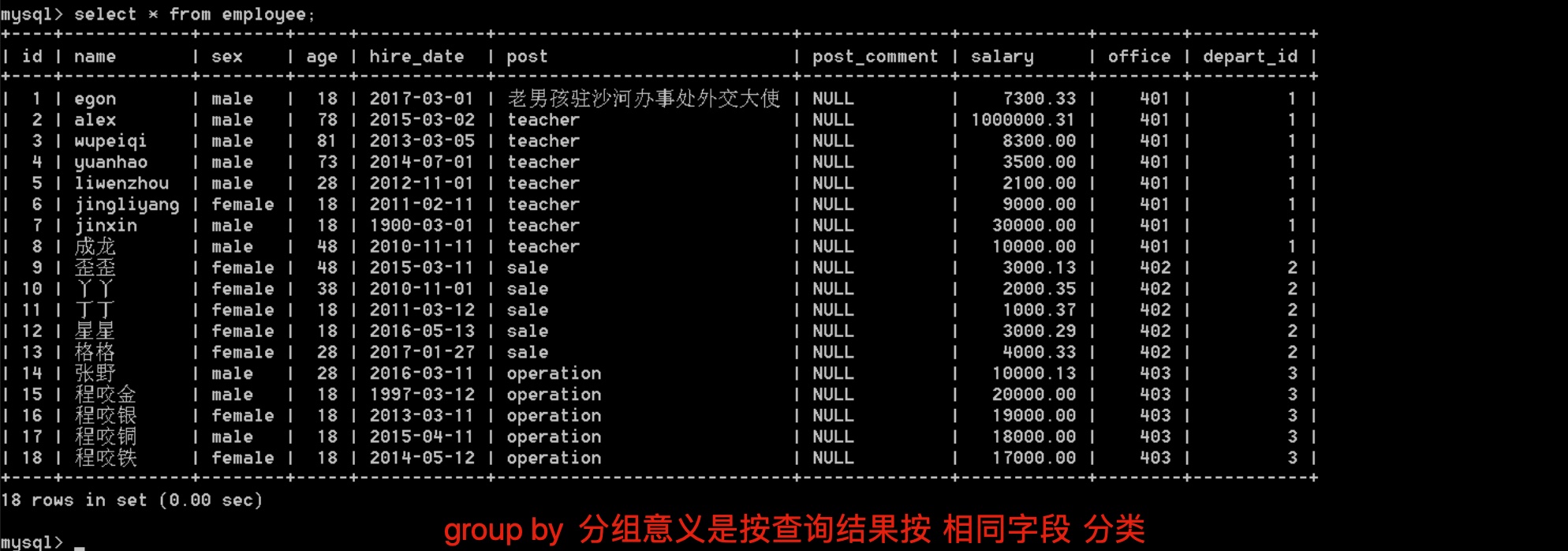
分组也就是分类,找出大家相同点。。。。。。

例如按照性别分组,分为两类,男和女,然后可以统计,男人有多少,女人有多少
也可以按照职位,入职时间分组,,大家的相同点。。。然后进行分组 归类
1.1.10. group by
知识点如下:
单独使用GROUP BY关键字分组
    SELECT post FROM employee GROUP BY post;
    注意:我们按照post字段分组,那么select查询的字段只能是post,想要获取组内的其他相关信息,需要借助函数

GROUP BY关键字和GROUP_CONCAT()函数一起使用
提示GROUP_CONCAT()函数,group_concat 用在 group 分组的时候,连接多行的字段拼接在一起。
    SELECT post,GROUP_CONCAT(name) FROM employee GROUP BY post;#按照岗位分组,并查看组内成员名
    SELECT post,GROUP_CONCAT(name) as emp_members FROM employee GROUP BY post;

GROUP BY与聚合函数一起使用
    select post,count(id) as count from employee group by post;#按照岗位分组,并查看每个组有多少人
1.1.11. 聚合函数
#强调:聚合函数聚合的是组的内容,若是没有分组,则默认一组
聚合函数:
count 统计数量
max     最大值
min        最小值
avg        平均值
sum        求和


示例:
    SELECT COUNT(*) FROM employee;  #统计员工信息有多少条
    SELECT COUNT(*) FROM employee WHERE depart_id=1;    #统计部门ID为1的员工个数
    SELECT MAX(salary) FROM employee;    #求最高的工资
    SELECT MIN(salary) FROM employee;  #求最低的工资
    SELECT AVG(salary) FROM employee; #求工资平均值
    SELECT SUM(salary) FROM employee;    #求所有工资总和
    SELECT SUM(salary) FROM employee WHERE depart_id=3; #求3号部门工资总和
案例
每个部门有多少个员工
技巧:每 字后面,就是分组依据
mysql> select post,count(id) from employee group by post;
+----------------------------+-----------+
| post                       | count(id) |
+----------------------------+-----------+
| operation                  |         5 |
| sale                       |         5 |
| teacher                    |         7 |
| 老男孩驻沙河办事处外交大使         |         1 |
+----------------------------+-----------+
4 rows in set (0.00 sec)
求每个部门最高工资
mysql> select post,max(salary) from employee group by post;
+----------------------------+-------------+
| post                       | max(salary) |
+----------------------------+-------------+
| operation                  |    20000.00 |
| sale                       |     4000.33 |
| teacher                    |  1000000.31 |
| 老男孩驻沙河办事处外交大使 |     7300.33 |
+----------------------------+-------------+
4 rows in set (0.00 sec)
求每个部门最低工资
求每个部门平均工资
求每个部门工资和
select post,min(salary) from employee group by post;
select post,avg(salary) from employee group by post;
select post,sum(salary) from employee group by post;
1.1.12. 分组练习题
1. 查询岗位名以及岗位包含的所有员工名字
2. 查询岗位名以及各岗位内包含的员工个数
3. 查询公司内男员工和女员工的个数
4. 查询岗位名以及各岗位的平均薪资
5. 查询岗位名以及各岗位的最高薪资
6. 查询岗位名以及各岗位的最低薪资
7. 查询男员工与男员工的平均薪资,女员工与女员工的平均薪资
题1
提示GROUP_CONCAT()函数,group_concat 用在 group 分组的时候,连接多行的字段拼接在一起
mysql> select post,group_concat(name) as member_name from employee group by post;
+----------------------------+-------------------------------------------------------+
| post                       | member_name                                           |
+----------------------------+-------------------------------------------------------+
| operation                  | 张野,程咬金,程咬银,程咬铜,程咬铁                      |
| sale                       | 歪歪,丫丫,丁丁,星星,格格                              |
| teacher                    | alex,wupeiqi,yuanhao,liwenzhou,jingliyang,jinxin,成龙 |
| 老男孩驻沙河办事处外交大使 | egon                                                  |
+----------------------------+-------------------------------------------------------+
4 rows in set (0.00 sec)
题2
mysql> select post,count(id) from employee group by post;
题3
mysql> select sex,count(id) from employee group by sex;
+--------+-----------+
| sex    | count(id) |
+--------+-----------+
| male   |        10 |
| female |         8 |
+--------+-----------+
2 rows in set (0.00 sec)
题4
mysql> select post,avg(salary) from employee group by post;
+----------------------------+---------------+
| post                       | avg(salary)   |
+----------------------------+---------------+
| operation                  |  16800.026000 |
| sale                       |   2600.294000 |
| teacher                    | 151842.901429 |
| 老男孩驻沙河办事处外交大使 |   7300.330000 |
+----------------------------+---------------+
题5
mysql> select post,max(salary) from employee group by post;
+----------------------------+-------------+
| post                       | max(salary) |
+----------------------------+-------------+
| operation                  |    20000.00 |
| sale                       |     4000.33 |
| teacher                    |  1000000.31 |
| 老男孩驻沙河办事处外交大使 |     7300.33 |
+----------------------------+-------------+
4 rows in set (0.00 sec)
题6
mysql> select post,min(salary) from employee group by post;
+-----------------------------------------+-------------+
| post                                    | min(salary) |
+-----------------------------------------+-------------+
| operation                               |    10000.13 |
| sale                                    |     1000.37 |
| teacher                                 |     2100.00 |
| 老男孩驻沙河办事处外交大使              |     7300.33 |
+-----------------------------------------+-------------+
题7
mysql> select sex,avg(salary) from employee group by sex;
+--------+---------------+
| sex    | avg(salary)   |
+--------+---------------+
| male   | 110920.077000 |
| female |   7250.183750 |
+--------+---------------+
2 rows in set (0.00 sec)
1.1.13. having过滤
#!!!执行优先级从高到低:where > group by > having
#1. Where 发生在分组group by之前,因而Where中可以有任意字段,但是绝对不能使用聚合函数。
#2. Having发生在分组group by之后,因而Having中可以使用分组的字段,无法直接取到其他字段,可以使用聚合函数
示例
查询各岗位内包含的员工个数小于2的岗位名、岗位内包含员工名字、个数
备注:
group_concat()会计算哪些行属于同一组,将属于同一组的列显示出来。
要返回哪些列,由函数参数(就是字段名)决定。分组必须有个标准,就是根据group by指定的列进行分组。
#拆分这个需求,以上信息都来自于员工表
select * from employee;

#想要每个岗位内的信息,也就是要对岗位进行分组
select * from employee group by post

#对岗位分组之后进行过滤,想要岗位内,员工个数小于2的,我们可以先筛选出每个岗位的人数
SQL是: select post,count(id) from employee group by post;
+----------------------------+-----------+
| post                       | count(id) |
+----------------------------+-----------+
| operation                  |         5 |
| sale                       |         5 |
| teacher                    |         7 |
| 老男孩驻沙河办事处外交大使 |         1 |
+----------------------------+-----------+
4 rows in set (0.00 sec)

然后注意having过滤是在分组之后,进行条件过滤,员工个数小于2的员工名字,和个数
select post,group_concat(name),count(id) from employee group by post having count(id)<2;
查询各岗位平均薪资大于10000的岗位名、平均工资
mysql> select post,avg(salary) from employee group by post having avg(salary) > 10000;
+-----------+---------------+
| post      | avg(salary)   |
+-----------+---------------+
| operation |  16800.026000 |
| teacher   | 151842.901429 |
+-----------+---------------+
2 rows in set (0.00 sec)
查询各岗位平均薪资大于10000且小于20000的岗位名、平均工资
select post,avg(salary) from employee group by post having avg(salary)>10000 and avg(salary) <20000;
1.1.14. 查询排序 order by
单列排序
#按工资从低到高排序,asc
SELECT * FROM employee ORDER BY salary;
SELECT * FROM employee ORDER BY salary ASC;

#按工资从高到低排序,desc
SELECT * FROM employee ORDER BY salary DESC;
按多列排序
#先age从小到大排序,如果相同,根据工资从小到高排序
 select * from employee order by age,salary asc;
排序综合练习
1. 查询所有员工信息,先按照age升序排序,如果age相同则按照hire_date降序排序
2. 查询各岗位平均薪资大于10000的岗位名、平均工资,结果按平均薪资升序排列
3. 查询各岗位平均薪资大于10000的岗位名、平均工资,结果按平均薪资降序排列
解答
mysql> select * from employee order by age,hire_date desc;

mysql> select post,avg(salary) from employee group by post having avg(salary)>10000 order by avg(salary);
+-----------+---------------+
| post      | avg(salary)   |
+-----------+---------------+
| operation |  16800.026000 |
| teacher   | 151842.901429 |
+-----------+---------------+
2 rows in set (0.01 sec)

mysql> select post,avg(salary) from employee group by post having avg(salary)>10000 order by avg(salary) desc;
1.1.15. 限制查询的记录数量limit
示例
#查询所有员工信息,根据薪资降序排序,显示前3名
select * from employee order by salary desc  limit 3;    #默认起点是0,查3条

#查询所有员工信息,根据薪资升序排序,显示前5名
select * from employee order by salary asc  limit 0,5;    #默认起始点是0,查5条

select * from employee order by salary desc limit 5,5;   #从第五条记录开始,即先出第六6条,向后5条
练习,显示出所有员工信息,每页5条记录
mysql> select * from  employee limit 0,5;
mysql> select * from  employee limit 5,5;
mysql> select * from  employee limit 10,5;